
Back to: HIV Stigma Workshop Kit
Learning about what stigma means, how it shows up, and the different types of stigma provides a solid foundation for understanding stigma and being able to explain it to others.
The Definition of Stigma
A set of negative, and often unfair, beliefs, biased-thinking, stereotypes, and prejudices about an individuals or group of people that show up in ways such as negative attitudes or discrimination.
The Two Sides of Stigma
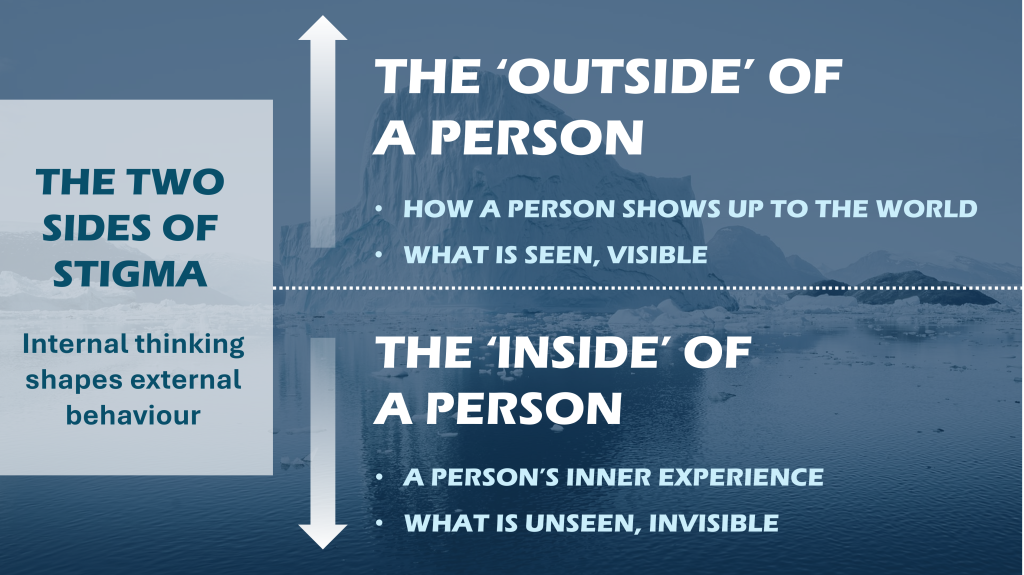
Stigma has both a visible side and an invisible side. The inner thoughts feed the outer behaviors. The ‘Outside’ of a person: how a person shows up to the world; what is seen, visible. The ‘Inside’ of a person: a person’s inner experience of thoughts and feelings; what is unseen, invisible. Internal thinking shapes external behaviour.
The Outside Part of Stigma (what is seen)
Negative Attitudes – How biased-thinking and prejudice show up in demeanor, behavior, action, and expression towards someone or something.
CLICK HERE to read about different types of negatives attitudes:
Microaggression – Subtle, often unintentional comments or actions that reflect biased-thinking, such as making backhanded compliments, assumptions, or insensitive remarks.
Negative nonverbal cues – Body language like avoiding eye contact, physical distancing, or showing discomfort can signal stigma even when nothing discriminatory is explicitly said or done.
Invasive curiosity – Persistent, prying questions or comments about someone’s life, condition, or personal experiences can reflect underlying stigma, as they suggest the person is “different” and their life is a subject of scrutiny.Condescension – Stigma can appear as overly sympathetic or patronizing behavior, where individuals are treated as helpless or inferior rather than as capable and autonomous.
Minimization – Happens when someone downplays or dismisses another person’s experiences, challenges, or harms (e.g., “It’s not that bad”, “You’re overreacting”).
Discrimination – The unfair or unjust treatment of individuals or groups based on someone’s characteristics, identity, condition, or life circumstances. Examples are things like race, gender, lifestyle, sexual orientation, or disability. Discrimination involves actions against people that result in disadvantages, diminished or denied access to services, or denial of rights.
CLICK HERE to read about different types of discrimination:
Denial of access – Being outright denied entry or participation in programs or service based on personal characteristics.
Social exclusion – Not including a person when social inclusion is a part of their health or publicly ostracizing someone in attempt to persuade others to enact stigma.
Preferential treatment – Providing positive benefit to some people but not others that can create inequity in delivery of programs & services.
Imposing barriers – Creating unnecessary work or ‘hoops to jump through’ for some people but not others.
The Inside Part of Stigma (what is unseen)
Biased-thinking – The tendency to favor or lean towards certain perspectives, beliefs, or types of people in a way that is often unconscious and not based on objectivity. Biases can be conscious or unconscious.
Prejudice – A preconceived and often negative opinion or perception about a person or group that is not based on reason or actual experience. It involves making negative judgments, assumptions, or misconceptions about someone based on being a part of a particular group of people.
Stereotyping – Making generalized beliefs about a group of people (e.g., “people living with HIV must have done something wrong in their life”). It’s usually an oversimplified mental image, whether positive or negative.
EXPLORE MORE
Personal Experiences of Stigma Survey (PAN) – In partnership with the Community Action Initiative and a working group of engaged community members and partners, explored how we can better evaluate the experiences of stigma and developed this survey inspired by research and evaluation in this area