
Back to: HIV Housing Toolkit
You are not required to tell a landlord that you have HIV.
It is illegal for landlords to deny rental housing to people because of their HIV status. However, discrimination persists, and it can be hard to prove and take action against. Many people living with HIV do not mention their HIV status when dealing with housing matters. This strategy can help to protect them from discrimination.
Some people living with HIV receive monthly income assistance, rental subsidies, or other forms of financial assistance. This can also lead to discrimination, even though landlords are not allowed to discriminate against prospective tenants based on source of income, as long as it’s legal. Often, landlords will screen out housing applicants who receive monthly income assistance They may even discourage individuals who receive monthly income assistance from applying for housing by stating in advertisements that they seek tenants who are “young professionals” or “working adults.”
Connecting with a housing worker can greatly help with navigating these challenges. Housing workers are knowledgeable about tenancy law, can help advocate for you, and may know landlords who are willing to rent housing to low-income people.
The landlord has the right to establish that you will be able to pay the rent. If they are not able to do so through your references, they are allowed to ask you for proof of income or current employment. Although they should not ask you why you receive monthly income assistance or a rental subsidy, they may anyway. In that case, you may want to try explaining that it is private information and that the important thing is you have a reliable source of income and will be able to pay your rent.
Landlords are not supposed to ask prospective tenants for more information than they need, but a 2018 investigation found that they often ask for too much personal information. If you’re wondering if a landlord is allowed to ask a particular question, you can check this resource or this report from BC’s Information and Privacy Commissioner. You always have the right to ask why a landlord wants a certain piece of information.
If you believe you have been discriminated against, talk to a support worker. You can contact the BC Human Rights Clinic if you are interested in filing a complaint.
Although discrimination may not always occur, stigma can still present itself in the form negative perceptions or attitudes. This downloadable document outlines different factors of stigmatization, how stigma appears, and the impact on housing and care. By being aware of these intersections of HIV related stigma and housing insecurity in BC, the can be more effectively prevented or addressed through action.
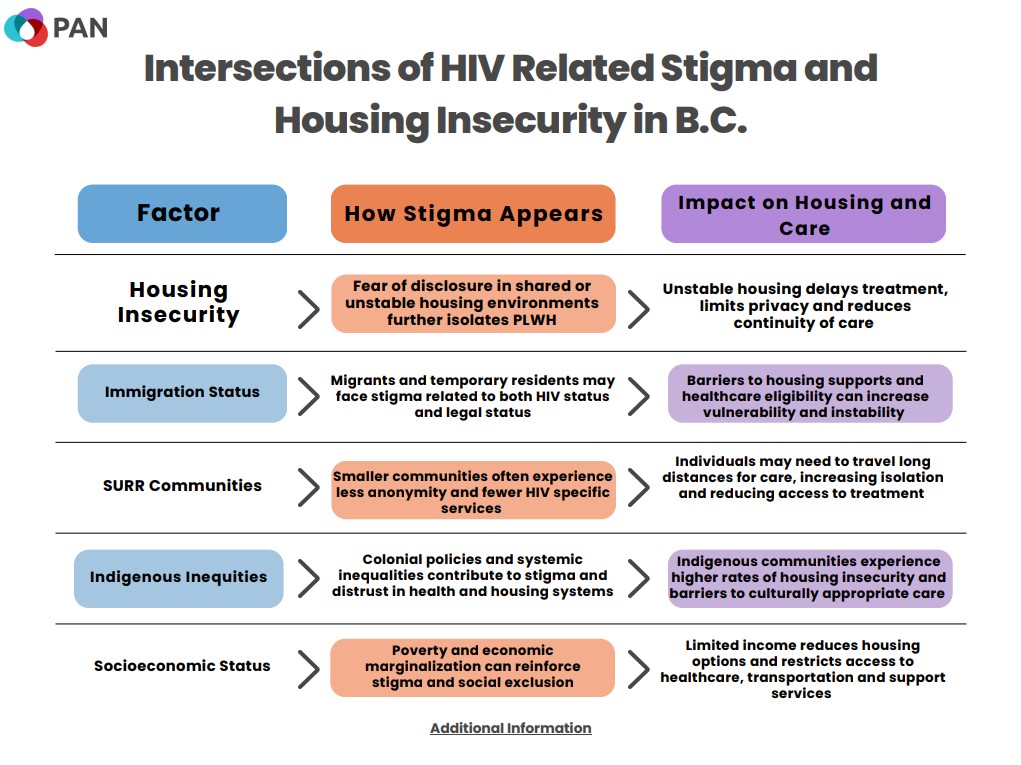
CLICK HERE to access this PDF resource
HIV-Specific Housing and Disclosure
A few areas in British Columbia have housing designated for people living with HIV. You can find out if this is available in your area by talking to an HIV or social services organization.
There are different kinds of HIV-specific housing—some provide health care, some offer support services, and others require fully independent living. This type of housing offers benefits for people living with HIV and is usually more affordable than other rental housing in British Columbia.
At the same time, HIV-specific housing brings a unique set of challenges related to disclosure.
Living in this kind of housing means that a person’s HIV status likely cannot be kept a secret. One of the most important concerns is involuntary disclosure—this is when a person’s HIV status is revealed without their consent. Sometimes this happens because someone (neighbour, staff) tells. Sometimes this happens because the information is learned some other way such as from a website.
There is even a chance of involuntary disclosure in the process of applying for HIV-specific housing. By filling out an application or going in and out of an HIV-designated building, people may reveal their HIV status. If you’re not comfortable with that, and you have other options, it might be best not to apply.
If you intend to live in HIV-specific housing, take some time to prepare for HIV disclosure. This means planning how you will tell people that you have HIV, as well as how you will respond if involuntary disclosure occurs.
You may also want to talk with people about why you live in HIV-specific housing, especially if you plan to invite guests over. What kind of health, support, social, or financial benefits will you be comfortable mentioning? For instance, you might talk about the community of support you have in the building, or you might discuss the affordability of the HIV-designated suite you live in.
Further Reading and Resources
HIV and Human Rights for National Human Rights Institutions
A handbook that covers various topics within the HIV/AIDS global context, such as the response from national human rights institutions, raising awareness on the intersection between HIV and human rights, and achieving universal access to HIV prevention, treatment, care, and support.